News
NEWS CENTER
The future of automotive air conditioning refrigerants hinges on low-GWP environmental friendliness, high efficiency adapted for new energy vehicles, and system intellectualization, all driven by mandatory global regulations. The period of 2026–2030 will be a critical transition phase.
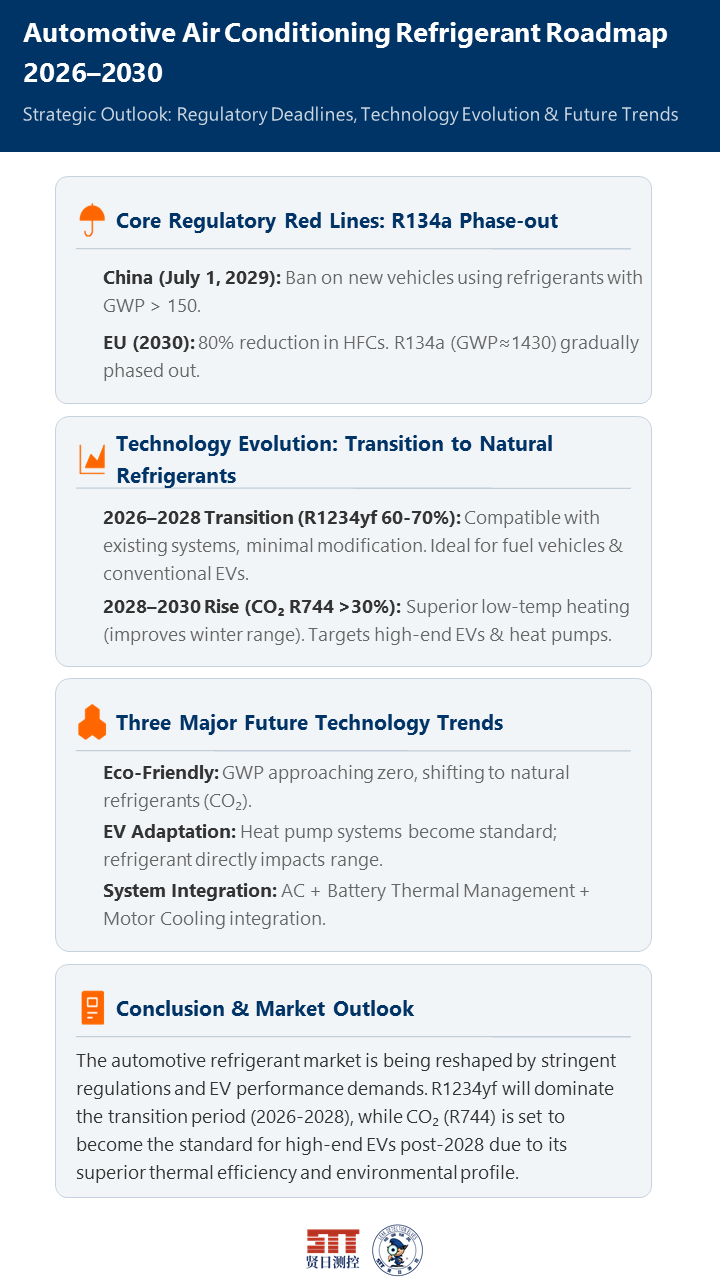
2026-2030 Roadmap for Automotive Air Conditioning Refrigerants, Compiled by STT Marketing Department
With the accelerated popularization of R744 (CO₂) refrigerant in heat pump systems of new energy vehicles, a core technical challenge has emerged: the operating pressure of R744 systems is 5 to 10 times that of traditional R134a systems, peaking at 200 bar. For sensors directly withstanding such pressure, their airtight performance is directly tied to the performance and safety of the entire heat pump system.
A world-leading sensor manufacturer (hereinafter referred to as "the Client") approached us, seeking a customized high-precision air tightness testing equipment for its pressure sensors applied to R744 air conditioning refrigerant. The R744 system operates at an ultra-high pressure of up to 200 bar, imposing extremely stringent requirements on the long-term sealing performance of sensors— a typical challenge faced by the Client and the industry at large.
1. High-Pressure Risks
Traditional testing methods fail to simulate the actual sealing state of sensors under high-pressure environments.
2. Micro-Leak Misjudgment
Minuscule leaks may cause slow refrigerant loss, compromising the lifetime service of the system and thus must be detected accurately.
3. Cycle Time Requirements
Mass production lines have strict testing cycle time demands, requiring a balance between precision and efficiency.
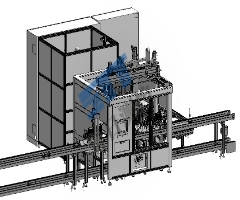
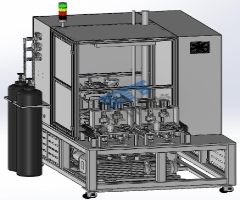
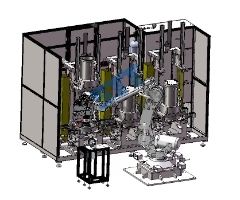
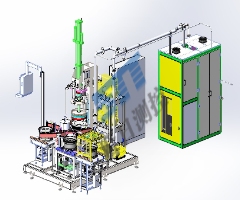
Tailored to the unique characteristics of the Client's sensors, STT provides a customized helium mass spectrometry leak detection solution. This solution is more than just a piece of equipment; it delivers a complete testing process.
1. High-Pressure Simulated Test Chamber
We have designed vacuum chambers and inflation fixtures tailored to the shape of sensors, which can accurately simulate the actual operating pressure environment of R744 during testing, ensuring consistency between testing conditions and real working conditions. STT currently boasts an ultra-high pressure testing capability of up to 70 MPa (700 bar), successfully applied in mass production-level projects, laying a solid foundation for meeting testing demands of higher pressure grades.
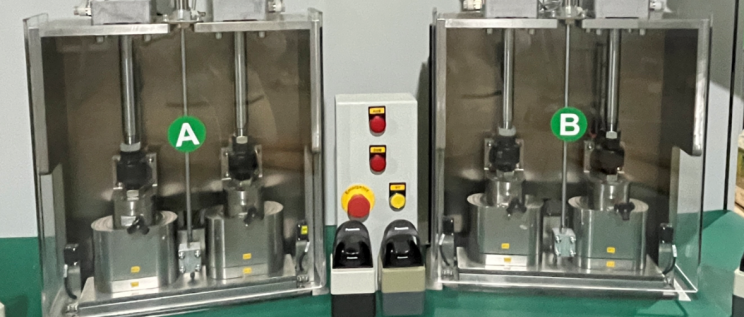
Close-up of STT Tooling Fixtures
2. Helium Tracer Technology
Utilizing helium as the tracer gas (characterized by small molecular size and strong penetration), combined with high-sensitivity mass spectrometry analysis technology, the solution can identify micron-level leaks that are undetectable by traditional pressure drop methods, minimizing the misjudgment rate to the lowest level.
3. Automated Production Line Integration
The equipment supports seamless connection with the Client's MES (Manufacturing Execution System). With fast testing cycle times and stable performance, it meets the Client's high-volume production needs. Testing data is uploaded in real time, and qualified and unqualified products are sorted automatically, fully complying with the automated cycle time requirements of the Client's production line.
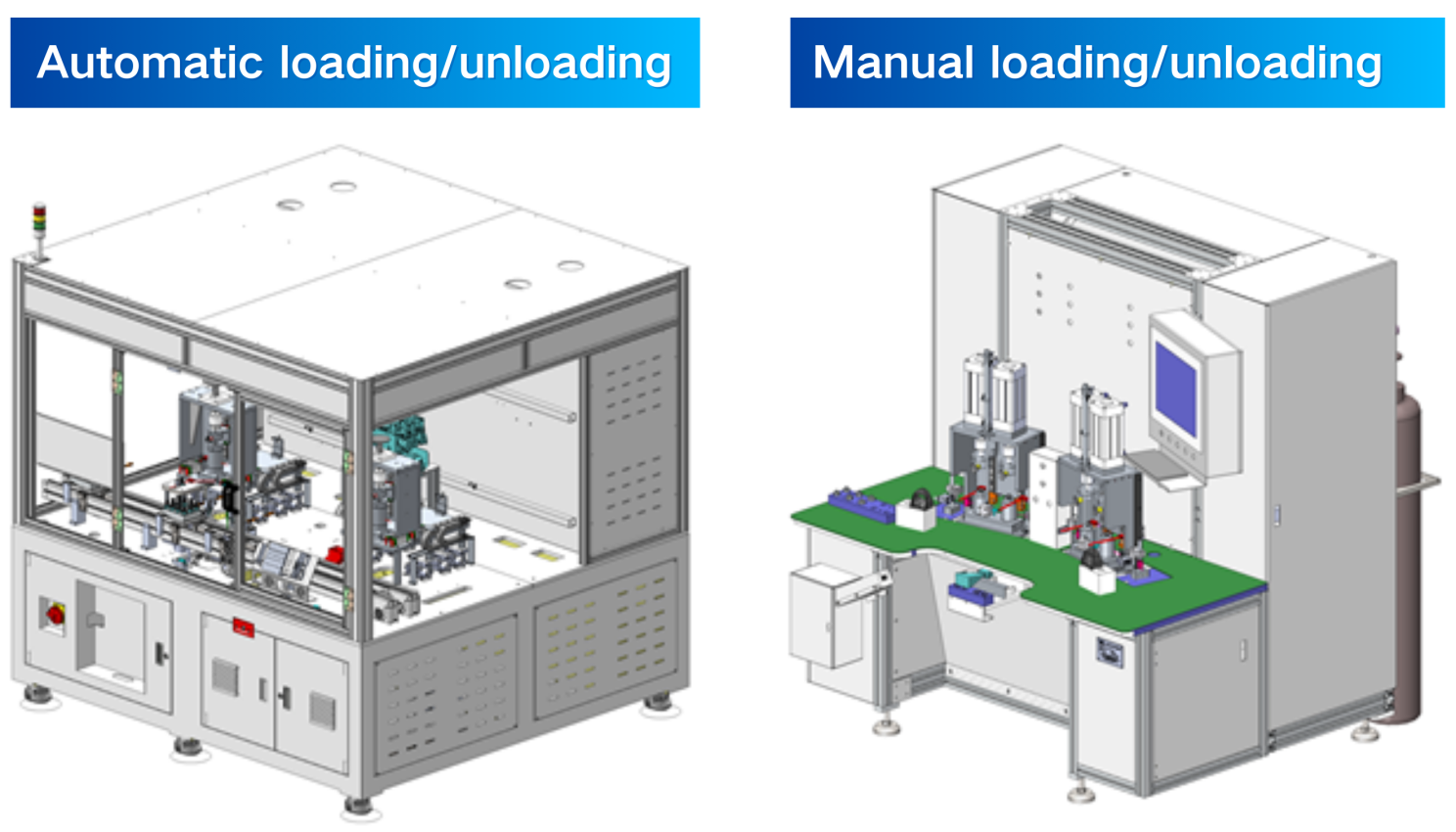
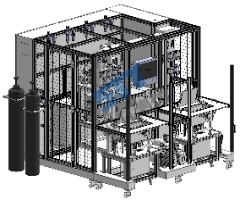
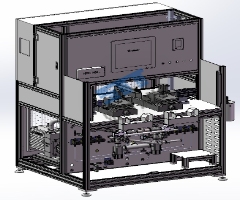
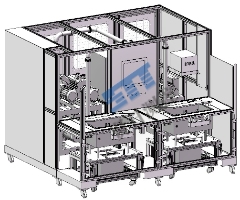
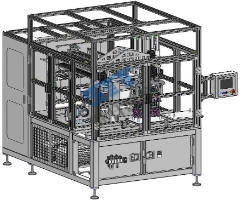
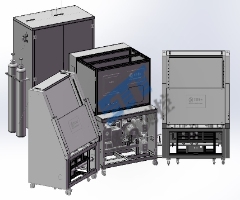
STT Helium Leak Detection Equipment for Sensor
Since the commissioning of this helium leak detection equipment, it has provided critical quality assurance for the Client's sensor mass production line:
1. Elevated Testing Precision
Stable detection of extremely low leak rates is achieved, ensuring every sensor delivered ex-factory can withstand the long-term challenges of high-pressure refrigerant.
2. Improved Production Line Efficiency
The automated testing process significantly reduces manual intervention, and the testing cycle time is fully matched with the production line capacity, realizing a seamless connection between production offline and testing.
Driven by carbon neutrality, the adoption of environmentally friendly refrigerants like R744 is inevitable.
If you are facing challenges with leak testing of high-pressure gas sensors or ensuring the seal integrity of components in new energy thermal management systems, contact us for a customized solution. For inquiries, please contact sales.sz@size-auto.com.